
Advertorial

My mother said the same sentence for years: I just hope my kids don't get this.

She lost her central vision at 71. I am 54. Last spring my optometrist used the phrase “some early changes, nothing to do yet” and I went home and could not sleep.

See what I found →
A quiet domestic kitchen in morning light
Her kitchen. The Amsler grid lived on the fridge for the last four years of it.

The thing nobody warns you about is how ordinary it looks from the outside. My mother did not go blind dramatically. She went blind by degrees, over about nine years, and most of that time she was still cooking, still on the phone, still telling me I worried too much.

What she lost first was faces. Not the whole face. The middle of it. She could see my hair, my shoulders, the shape of me in a doorway, and where my features should have been there was a smudge she had to look around.

She kept an Amsler grid on the fridge and checked it every morning with one eye covered, the way she had been told to. For a while the lines were straight. Then one morning in March they were not, and she stood in the kitchen and did not tell anybody for four days.

She said one sentence more than any other in those years, usually while looking at something else. I just hope my kids don't get this.

“I am 54. Last spring the optometrist said there were some early changes, and nothing to do yet.”

What “nothing to do yet” actually means

I want to be fair to him, because he was not being careless. On the current standard of care he was right: for early changes there is no treatment to start. The injections come later, if things move, and they are not something anyone begins early for the sake of it.

But I drove home from that appointment with a folder of nothing, and a very clear picture in my head of a kitchen with a grid on the fridge. Being told there is no action available is a different experience when you have already watched where the road goes.

What I did in the twelve months after

In the honest order, not the sensible one.

A hand writing on paper at a desk
The notebook I started the week I found out it runs in families.

What I could not find, in any of it, was an explanation of the mechanism that anyone had bothered to give a patient. Everything was risk factors and statistics. Nothing was about what is actually happening.
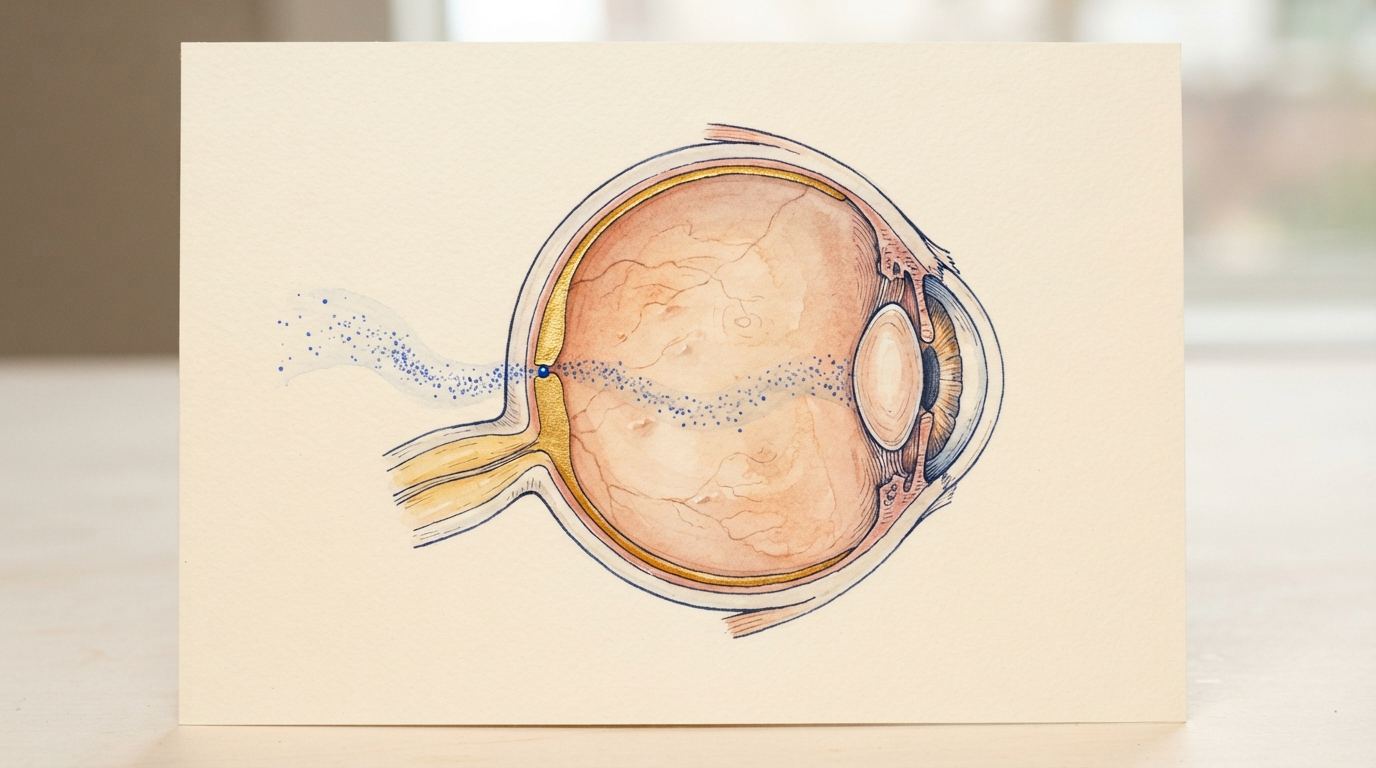
A hand-drawn cross-section of the human eye

The study almost nobody gets shown

It is called the Alienor study, run in Bordeaux. Not a laboratory and not mice. Ordinary older people, mean age near eighty, followed over years. What they measured was esterified 3-hydroxy fatty acids in blood, used as a proxy for how much bacterial endotoxin a body is carrying.

Their finding, published in Investigative Ophthalmology & Visual Science: participants with higher levels of that marker had a higher rate of developing early age-related macular degeneration. The hazard ratio was 1.21 for each standard deviation of increase, and it held after adjusting for age and sex.

Here is the other half, because a page that only quotes the flattering number does not deserve to be believed. The same study found no significant association with advanced macular degeneration. The authors say plainly that only randomized clinical trials can prove that one thing causes the other. This is an association in one cohort of very old French adults. It is not proof.

I want to be precise about why that mattered to me. It is not a cure and it is not a promise. It is the first thing anyone put in front of me that described a process rather than a probability, and after a year of being handed percentages that was worth something.

What I finally tried

So I went looking for a formula built around that idea instead of the usual eye vitamins.

Most eye supplements are the same short list, and I had already been through it: lutein, zeaxanthin, zinc, a lot of vitamin E. All of it aimed squarely at the eye. The one I ended up taking has twenty-two ingredients, and the eye half of that list is unremarkable.

The part that made me buy it is the other four. Grape seed extract, rutin, quercetin and taurine, which are there for the gut barrier rather than the retina, alongside alpha lipoic acid. It is the only formula I found that had read the same literature I had.

Where I actually am now

I have been taking it since March. My next appointment is in the fall and I have no idea what it will say.

What has changed is not my vision. It is that I stopped feeling like a person waiting for something. For a year after that appointment I was checking the grid every morning the way she did, with the same cold feeling, doing nothing else because there was nothing else offered.

I am aware that is a psychological benefit rather than a clinical one, and I am not going to dress it up as more than it is. But if you have watched this happen to somebody, you will know that the waiting is its own condition.

My mother took her vitamins for nine years and went blind anyway. I have thought about that a great deal while writing this, and it is the reason there is no promise anywhere on this page. What changed for me was understanding the process. That is smaller than a cure and it is not nothing.

“Is this one of those miracle pills?” That is exactly what I thought too.

I have been on this earth long enough to have my guard up. So before I say where to read the rest, let me say plainly what this is not.

Read a hundred reviews of any eye supplement and count how many people say they can see better. Almost none. What they say is that it has not got worse. After two years of watching it get worse on a schedule, that turned out to be the thing I actually wanted.

If you have watched this happen to someone and you are now the one in the chair, it is worth ten minutes to read how it works.

See what is in it →

Sold only on the official page. I earn a commission if you buy, at no extra cost to you.