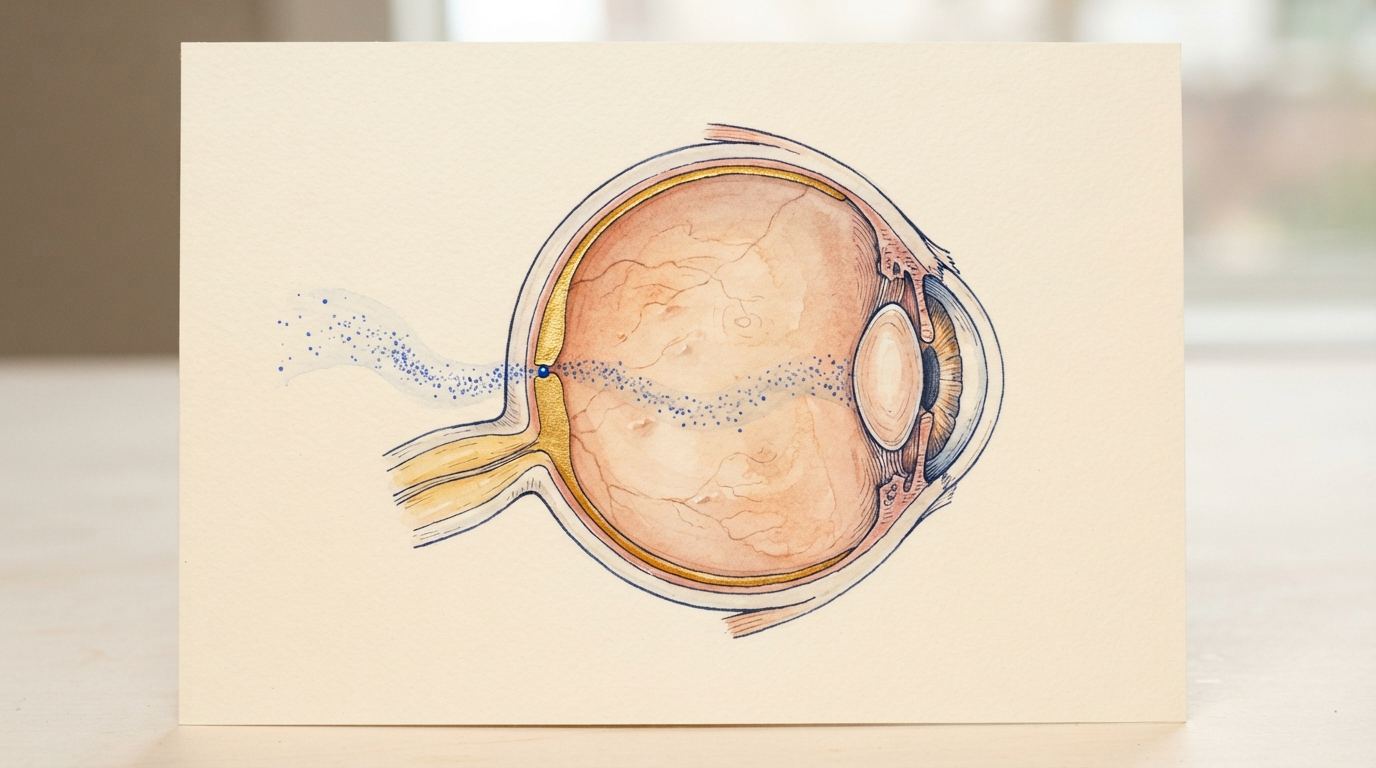
People describe them the same way regardless of age or country. A hair. A fly. A gnat that darts away when you look at it. Cobwebs, squiggles, a ring. Almost everyone reports trying to brush one off their face at least once before understanding what it was.
The standard clinical advice is that most floaters are harmless and that the brain will learn to ignore them. Both halves of that are broadly true. Neither half is an explanation, and the second half does not happen for everyone.
What the advice does not address is why they appeared. The vitreous, the gel filling the eye, becomes less uniform with age; collagen clumps and casts shadows on the retina. That much is textbook. Why it happens faster in some people than in others is a much thinner literature.
The gap between “harmless” and “explained” is where a very large number of frustrated people are currently sitting, having already tried the remedies that circulate in forums: eye exercises to flick them aside, dark sunglasses, hydration, and a series of supplements bought on the strength of a single enthusiastic post.
“Any new flash of light, a sudden shower of floaters, or a shadow at the edge of vision needs a same-day eye examination. That is not this page's subject and it is not optional.”
The study almost nobody gets shown
It is called the Alienor study, run in Bordeaux. Not a laboratory and not mice. Ordinary older people, mean age near eighty, followed over years. What they measured was esterified 3-hydroxy fatty acids in blood, used as a proxy for how much bacterial endotoxin a body is carrying.
Their finding, published in Investigative Ophthalmology & Visual Science: participants with higher levels of that marker had a higher rate of developing early age-related macular degeneration. The hazard ratio was 1.21 for each standard deviation of increase, and it held after adjusting for age and sex.
Here is the other half, because a page that only quotes the flattering number does not deserve to be believed. The same study found no significant association with advanced macular degeneration. The authors say plainly that only randomized clinical trials can prove that one thing causes the other. This is an association in one cohort of very old French adults. It is not proof.
The limits are worth stating twice. This is one cohort, in one country, in a very old age group. The association was with early disease and not advanced disease. Observational work of this kind cannot establish that one thing causes another, and the authors say so themselves. Anyone selling certainty off the back of it is going beyond what it shows.